 By Furqan Khan
Context
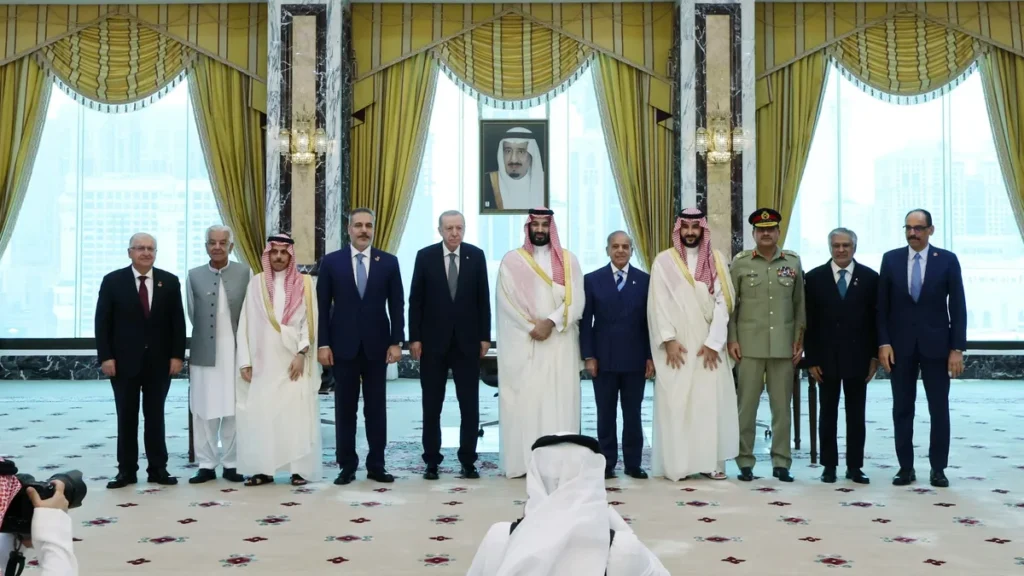
On August 7, Pakistan, Turkey, and Saudi Arabia signed a joint defense agreement stipulating that an armed attack against one member will be regarded as an attack against all. The agreement, known as the Mecca Joint Defense Agreement, is significant because it brings together three powerful Sunni-majority states under a collective-defense framework at a time when the Middle East’s established security order is under considerable strain. Although the pact has attracted attention primarily because of its resemblance to NATO’s Article 5, its broader significance lies in the institutionalization of defense cooperation among Saudi Arabia, Pakistan, and Turkey. The agreement envisages greater political and military coordination and provides a framework for strengthening joint exercises, defense cooperation, and military-industrial collaboration. Turkey has also indicated that the framework could eventually be expanded to include other regional states.
The Mecca agreement should therefore be understood less as a fully developed military alliance than as an emerging regional security mechanism. Its importance derives from the strategic environment in which it was created: declining confidence in the reliability of the existing U.S.-led security architecture, continuing confrontation with Iran, concerns about Israel’s regional conduct, and growing interest among Middle Eastern states in developing greater indigenous capacity for deterrence.
Disordering Regional Security Environment
For nearly five decades, the United States has been the principal external security guarantor for its allies and partners in the Middle East. Its military deployments, defense relationships, and security commitments helped create an environment intended to protect energy infrastructure, maritime routes, and allied governments while preventing any single regional power from dominating the strategic landscape.
The geopolitical changes associated with the Iran war have placed that model under significant pressure. The conflict, which began in February with U.S. and Israeli attacks on Tehran, has exposed limitations in Washington’s ability to simultaneously deter Iran, protect its regional partners, and preserve freedom of action. The resulting uncertainty has encouraged regional states to consider additional security arrangements rather than relying exclusively on American guarantees.
The United States’ difficulties in protecting its Arab partners from Iranian attacks have been particularly consequential for Saudi Arabia. There is growing concern among regional partners about Washington’s reliability. Saudi Arabia has subsequently sought to diversify its security partnerships rather than remain dependent on a single external guarantor. This development is not necessarily inconsistent with the Trump administration’s emphasis on burden-sharing and reducing the costs of U.S. security commitments abroad. A greater willingness by regional partners to assume responsibility for their own defense could, in principle, complement Washington’s objective of reducing its direct military burden.
The problem, however, is one of perception. Burden-sharing produces different strategic effects when it is interpreted as greater allied responsibility and when it is interpreted as evidence that the United States can no longer be relied upon in a crisis. The Mecca agreement is, at least partly, a product of that credibility gap. It reflects Saudi Arabia’s willingness to seek alternative sources of deterrence and Pakistan and Turkey’s willingness to assume larger security roles in the region.
The agreement is also connected to Arab concerns about Israel – and the extent to which regional government’s view Israel’s military policies as another source of instability. Thus, the agreement cannot be explained solely as a response to Iran or solely as a reaction to declining American influence. It reflects a wider reassessment of the regional balance of power.
Mecca Agreement and Board of Peace
The relationship between the Mecca agreement and the Trump administration’s regional strategy is likely to be one of the most consequential questions surrounding the pact. At first glance, the two frameworks could appear competitive. The administration’s earlier regional vision, centered on the Abraham Accords, placed considerable emphasis on Arab-Israeli normalization. A security arrangement centered on Saudi Arabia, Turkey, and Pakistan could instead encourage a parallel regional bloc whose strategic identity is based more explicitly on collective defense among Muslim-majority states.
Yet the two initiatives need not be mutually exclusive. President Trump reportedly described the Mecca agreement on August 16 as a “big, bold, and important first step”, suggesting that Washington does not necessarily regard the new arrangement as incompatible with its broader regional strategy. The more interesting possibility is that the two frameworks could eventually become complementary. The Board of Peace is accompanied by an International Stabilization Force (ISF) and associated security-architecture components.
The ISF is envisioned as a temporary multinational security and stabilization force, authorized under UN backing, operating under a unified command acceptable to the Board of Peace. Its responsibilities include maintaining public order, protecting reconstruction corridors, supporting humanitarian operations, and coordinating with Egypt and Israel while assisting a newly recruited local Gaza police force. The force is intended to provide an enforcement mechanism for maintaining territorial calm alongside phased Israeli military withdrawals and militant disarmament.
This creates a potential role for countries participating in the Mecca framework. Muslim-majority states could provide political legitimacy, personnel, equipment, or other forms of support for regional stabilization efforts. The difficulty, however, is Israel’s opposition to certain potential contributors. Israel has previously resisted the presence of Turkish armed forces in Gaza, while Israeli officials have also expressed reservations about Turkey’s participation in a future stabilization force.
The underlying dispute is therefore less about whether Muslim-majority countries can participate in stabilization than about who controls the mandate, composition, and rules of engagement of such a force. Israel has not rejected the ISF concept itself; rather, its principal concern is the identity and mandate of participating forces and whether they can independently influence Gaza’s security environment. Israel insists that Hamas must be disarmed and its military infrastructure dismantled before a full Israeli withdrawal. Prime Minister Netanyahu has continued to reject withdrawal until full disarmament is achieved.
This creates an important tension: Washington and the Board of Peace may see regional Muslim participation as essential to the legitimacy and implementation of the Gaza framework, while Israel remains concerned that participating states could acquire an autonomous security or political role.
What Would Trigger Collective Defense?
The central uncertainty surrounding the Mecca agreement concerns the practical meaning of its collective-defense provision. An attack on one member being treated as an attack on all does not necessarily mean that every member would automatically enter a war. The precise military obligations remain insufficiently defined. Critical questions include whether the provision applies only to attacks by states or also to non-state actors; what threshold constitutes an “attack”; and whether assistance would require combat deployments or could instead involve intelligence, air defense, logistics, maritime surveillance, cyber capabilities, or other forms of support.
The three members also have different threat perceptions. Pakistan’s principal security concerns remain concentrated in South Asia, while Turkey’s strategic interests extend across Syria, Iraq, the eastern Mediterranean, and the Caucasus. Saudi Arabia’s immediate concerns are centered more heavily on Iran, Yemen, missile and drone threats, and the protection of critical infrastructure. For that reason, the agreement should not be interpreted as a guarantee that Pakistan and Turkey would automatically fight every adversary confronting Saudi Arabia. Pakistan’s historical position on Yemen illustrates the distinction between political support for Saudi Arabia and participation in Saudi-led military operations. In 2015, Pakistan’s parliament rejected Riyadh’s request to participate directly in the Yemen intervention. At the same time, Pakistan’s current military relationship with Saudi Arabia demonstrates that limited or defensive assistance can be substantial. Pakistan has already deployed thousands of troops and a fighter-jet squadron to Saudi Arabia during the Iran war, along with other air-defense capabilities, under a separate Strategic Mutual Defense Agreement (SMDA). The agreement was signed between Pakistan and Saudi Arabia last year.
If a state, or a non-state actor, were to launch a major attack on Saudi territory, critical infrastructure, or if the Kingdom’s sovereignty is threatened, the collective-defense provision would presumably become more relevant. Even then, the most likely initial response could involve defensive assistance: intelligence sharing, air-defense systems, counter-drone capabilities, maritime surveillance, logistics, and other forms of military support rather than immediate offensive operations.
The agreement’s effectiveness will therefore depend less on whether it replicates NATO’s Article 5 literally and more on whether the three governments can establish credible mechanisms for consultation, coordination, intelligence sharing, military interoperability, and crisis response.
What Does the Mecca Agreement Bring Home?
For Saudi Arabia, the agreement offers two strategic benefits: additional deterrence and greater regional leadership. Faced with Iranian and Houti attacks and uncertainty over the reliability of U.S. protection, Riyadh gains an institutional mechanism through which it can diversify its security relationships. For Pakistan and Turkey, the agreement expands their regional strategic profiles. Both countries already possess significant defense relationships with Saudi Arabia, while Pakistan and Turkey have developed extensive bilateral military cooperation. The Mecca agreement gives these relationships a broader institutional framework. According to the Turkish Defense Ministry, the fundamental goal of the agreement is to place existing military ties on a more “institutional and sustainable” basis.
The possibility of additional states joining also gives the agreement longer-term significance. Turkey has indicated that the framework could be expanded, with Egypt among the countries potentially relevant to its future development. The agreement has also been described by Pakistani officials as open to other countries in the region. A larger membership could eventually produce something resembling a “Muslim NATO,” although that comparison should be treated cautiously. NATO’s institutional depth, integrated command structure, standardized forces, and decades of operational experience are not currently replicated by the Mecca framework.
The strategic implications nevertheless extend beyond the three signatories. The emerging security arrangements in West Asia have consequences for American interests and influence. Washington’s declining agency in the regional security architecture could create greater opportunities for China and Russia to expand their diplomatic and strategic influence. More importantly, it signals that regional states increasingly regard security diversification as necessary even while maintaining relationships with the United States.
Conclusion
The Mecca Joint Defense Agreement is best understood as a product of a changing Middle Eastern security environment rather than simply as the creation of a new military alliance. The Iran war, uncertainty surrounding American deterrence, persistent Israeli-Arab tensions, and the wider fragmentation of the regional order have encouraged Saudi Arabia, Pakistan, and Turkey to institutionalize defense cooperation. The agreement’s collective-defense provision is politically significant, but its military implications remain uncertain. The absence of clearly defined automatic obligations means that it should not yet be equated with NATO. Its immediate value lies in creating mechanisms for consultation, joint exercises, defense cooperation, technology development, and potentially coordinated responses to regional threats. Its durability will depend on whether the three members can reconcile their divergent threat perceptions and translate political solidarity into credible military interoperability.
The larger significance of the Mecca agreement, therefore, is not simply how many troops Pakistan or Turkey might commit in a future conflict. It is that three important regional powers are attempting to create a security mechanism that reduces dependence on any single external guarantor. If the framework expands and develops effective institutional and operational capabilities, it could become an important component of a more pluralistic security order in West Asia.
The emerging arrangement does not necessarily signal the end of American influence. Rather, it indicates that U.S. influence may increasingly operate alongside regional security structures that Washington does not fully control. The Mecca agreement may consequently prove significant not because it immediately creates a “Muslim NATO,” but because it represents another step toward a Middle Eastern security architecture in which regional powers assume a greater share of responsibility for their own deterrence and strategic stability.
Related Articles
US-Iran War And Alternative Futures For South Asia – August 30, 2026
US-Iran Interim Ceasefire Deal, Israel, And The Future of Abraham Accords – June 18, 2026
The US-Israel and Iran Conflict: The Interplay of Goals and Strategies – May 1, 2026
Geopolitics Of Islamic World And Middle Power Alliances After Iran Attack – Mar 22, 2026
The End Of Strategic Altruism: Putin’s Visit And The New US-India Reality – Jan 13, 2026
From Oslo To Trump’s Abraham Accords And 20-Point Peace Plan For Gaza – Oct 12, 2025
Israel Airstrike Targets Hamas Negotiators In Doha, Threatening Gaza Ceasefire Talks – Sep 15, 2025
Gaza Ceasefire Plan And US-Iran Tensions – April 26, 2025
Two-State Solution, Future Of Gaza, And Iran – February 25, 2025
Assad’s Demise And The Shifting Balance Of Power In Middle East – Dec 26, 2024
The Escalating Middle East Crisis And President Elect Trump – Dec 5, 2024
China’s Belt And Road Initiative And India-Middle East-Europe Corridor (IMEC) – Oct 5, 2023
Iran’s Potential Retaliation For Haniyeh’s Killing And Wider Consequences – Aug 30, 2024
The Iran-Pakistan Gas Pipeline Project: Economic and Geopolitical Realities – Sep 27, 2024
Great Power Rivalry And China’s Deepening involvement In South Asia, Gulf States – Aug 4, 2023
What Does President Biden’s Visit To Israel And Saudi Arabia Imply? – Aug 4, 2022