How Putin’s Visit, Venezuela Crisis, and Shifts in the Middle East and Afghanistan are Testing New Delhi’s Foreign Policy
By Furqan Khan
Great Power Politics Fellow
When Russian President Vladimir Putin arrived in New Delhi in December last year to attend the 23rd annual India-Russia summit, expectations were ripe for breakthrough agreements in energy and defense. Yet, despite the two countries agreeing to expand economic cooperation and reaffirming their “special and privileged strategic partnership,” no concrete measures were announced in advancing energy and defense cooperation.
Putin’s visit, however, came at a crucial time when the United States is pressing Kremlin to end the war in Ukraine, while India’s relations with Washington are under strain. At the same time, continued US pressure on India’s purchases of Russian crude, the imposition of punitive tariffs, and America’s renewed engagement with Pakistan have pushed India to seek alternative partnerships. This happens alongside a broader shift in American strategy, reflected in the Trump administration’s newly announced 2025 National Security Strategy (NSS), which signals a shift away from the allied-centric leadership to a more transactional, burden-sharing approach.
When viewed against these systemic shifts, Putin’s visit holds greater strategic value for both Moscow and New Delhi, even when the tangible outcomes were limited. Based on the recent developments in January, specifically the US military operation and the subsequent “US-controlled” oil framework, the Venezuela crisis has become a critical lever in US-India relations.
Symbolism – Not So much Substance
Putin’s visit, first by the Russian President since Moscow’s invasion of Ukraine in February 2022, attracted widespread attention. Although the two leaders met elsewhere, including in Moscow and Tianjin in 2024 and 2025, respectively, this visit holds a distinct strategic significance. The two countries signed agreements on pharmaceuticals, critical minerals, and tourism, and also finalized an economic cooperation arrangement to increase their bilateral trade to $100 billion by 2030. However, the summit was more significant for what was not announced: oil and weapons deals.
Putin expressed readiness to supply “uninterrupted shipments” of fuel to India; however, New Delhi remained cautious about the offer. According to the Indian foreign secretary, decisions by Indian oil companies are driven by the “evolving market dynamics” and “commercial issues” they confront while sourcing their supplies, signaling US sanctions as a potential challenge. Similarly, defense cooperation also fell short of expectations. There were reports that weapons sales would be on the agenda of President Putin’s visit. In particular, the defense ministers from both sides were expected to discuss the timely delivery of the remaining units of the S-400 air defense system, which India purchased from Russia in 2018. Potential collaboration on the joint production of the next-generation S-500 system was also on the cards. However, no such agreements were finalized.
India was likely concerned by the potential repercussions of any high-profile defense deal over its already strained relations with the US, especially when New Delhi is working to negotiate a favorable trade deal with Washington.
Nonetheless, despite the absence of a substantive breakthrough, Putin’s visit was a symbolic show of strategic recalibration in the face of the American pressure. Greeting Putin with a red carpet offered India an opportunity to display its strategic autonomy and signal that India’s relationship with Russia is far from over. For Putin, as he is navigating tough negotiations to end the war, the visit signaled that despite Western attempts to render Russia a pariah, it still has friends of global significance. Therefore, even though fewer concrete steps were taken, the visit pumped energy into their “special and privileged strategic partnership.”
Testing the Strength of India-Russia Relations
Putin-Modi talks were watched closely in Washington, where sanctions are testing the strength of this bilateral relationship. The Trump administration has been pressuring Kremlin to end its nearly four-year war in Ukraine, while urging India to stop buying Russian oil, after accusing New Delhi of indirectly financing the war. Trump’s advisor Peter Navarro even called it “Modi’s War,” highlighting the significant rise in India’s purchases of Russian crude, from 0.2 percent before the war to 40 percent today. Consequently, the Trump administration imposed a whopping 50 percent tariff on Indian imports, of which 25 percent is punitive for buying Russian oil and weapons.
India has become the second-largest importer of Russian oil, after China, and more than a third of its oil imports have come from Russia over the past three years. However, this appears to be changing after the American sanctions recently targeted Russia’s two biggest oil giants, Rosneft and Lukoil, which might affect Indian oil companies, some of which have already stopped buying Russian oil. However, the decision to halt oil imports appears to be a temporary move by New Delhi to adjust for a favorable trade deal with Washington. During Putin’s visit, Modi reiterated his careful position on the Ukraine war, saying that India is not neutral in this conflict but stands on the “side of peace.”
Trump’s New Strategic Blueprint in National Security Strategy (NSS-2025)
The Trump administration’s approach towards India and the broader Indo-Pacific region is reinforced by the recently announced NSS, which departs from the strategic competition narrative and recognizes the existence of other “stronger nations” as a “timeless truth of international relations.” It reduces Russia from an “acute threat” to a challenge of managing its relations with the European Union, and downgrades China from a “pacing challenge” to an actor with which the US seeks to balance its economic relationship, avoiding the term strategic competitor. Nonetheless, the strategy expresses a commitment to “work with allies and partners” to preserve the balance of power.
For the last two decades, the American grand strategy has focused on preventing the rise of China as its peer competitor, in which India has been a critical partner. This seems to be changing under the new strategy, which expects India and other allies to address their challenges on their own under the burden-sharing principle. This shift indicates a potential erosion of India’s strategic exceptionalism in America’s strategy that New Delhi has enjoyed over the last two decades.
This shift in strategy is also reflected in the diminishing role of the Quadrilateral Security Dialogue (Quad) – a four-member Indo-Pacific alliance of Australia, Japan, India, and the US, which is losing its momentum. The NSS mentions Quad only once, while calling for improved commercial relations with India to “encourage New Delhi to contribute more” to the Indo-Pacific security. However, described as “more strategically aligned than ever before ” a year ago by President Biden, Quad has drifted into uncertainty under President Trump. Last year’s Quad summit, scheduled to be hosted by India in November and which Trump was reportedly reluctant to attend, did not go through, as India-US relations unraveled.
Trump has apparently broken Biden’s policy of strategic altruism that considered support for India’s major power status consistent with the US national interest. The current approach has been more transactional with the expectation of a direct quid pro quo.
Given these signals, India appears to be adjusting its diplomatic engagement in a hedging mode. Putin’s visit is part of that strategy, but it does not end in Russia. In September 2025, Modi was seen exchanging warm gestures with Chinese President Xi Jinping in Tianjin, both rejecting the notion of rivalry and instead calling each other development partners. China-India trade relations have also improved steadily over time since 2005, even though the US remains India’s largest trading partner. However, many in New Delhi believe that this is not a desirable position for India, one that it does not seek but is forced into by the Trump administration’s policies. At the same time, Washington has criticized India’s BRICS membership for the bloc’s revisionist ambitions against the West.
Against this backdrop, India’s rapprochement with China, and rolling out the red carpet for President Putin can, at best, ensures strategic autonomy for New Delhi without affecting the foundational basis of Indo-US strategic partnership.
US-India Ties and Pakistan
These regional and global shifts have significant consequences for South Asia, particularly as Trump’s embrace of Pakistan in recent months factors into India’s strategic calculations. The way Trump and his advisors have publicly criticized Modi’s government, especially after the May conflict with Pakistan, Modi’s diplomacy is also guided by a sense of political liability, where conceding to the US demands risks domestic political backlash.
After the India-Pakistan conflict in May, following a terrorist attack in Pahalgam (Indian administered Kashmir) last year, Pakistan credited Trump for the ceasefire and backed his nomination for the Nobel Peace prize, unlike India, which refused to give a similar credit. Trump’s reaction to the Pahalgam attack was a break from the past American presidents, who supported India and pressured Pakistan to crack down on militants allegedly operating from its soil. Instead, Trump showered praise on Pakistan’s civil-military leadership, credited Islamabad for the ceasefire in Gaza, and invested heavily in the country’s untapped critical minerals reserves.
Additionally, America’s defense cooperation with Pakistan, which India has consistently opposed, especially the recent US approval for the sale in support of Pakistan’s F-16 fleet worth $686 million, is likely to be received poorly in New Delhi. Washington has justified close defense cooperation with Islamabad as essential to counterterrorism, saying that the sale will “not alter the basic military balance” in South Asia. Taken together, the growing US tilt towards Pakistan potentially revokes Indian monopoly over Washington’s South Asia policy, creating space for Pakistan to maneuver while encouraging New Delhi to seek partnerships away from the US.
Evolving Middle East and Afghanistan
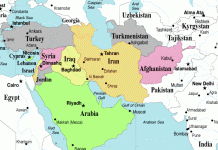
India’s foreign policy is also facing challenges in the evolving geopolitics of the Middle East and Afghanistan. The nation maintains good relations with both Russia and Iran, yet it is also growing its ties, particularly in the defense sector, with Israel, which puts New Delhi in a critical position to navigate this balancing challenge. This dilemma is also visible in the recent tensions between Saudi Arabia and the United Arab Emirates (UAE) in Yemen, where Iran is a major actor. As India’s energy, trade, and diaspora interests are deeply embedded in the Gulf states, navigating the conflict between the Gulf states as well as maintaining its relations with Israel and Iran becomes a critical challenge.
On the other hand, while only Russia recognizes the Taliban regime in Kabul, India is also expanding its ties with the Taliban regime in Kabul, recognizing the latter’s strategic relevance vis-à-vis Pakistan. This has happened in parallel to Pakistan’s continuing loss of leverage in Kabul, driven by the Taliban regime’s inability to crack down on anti-Pakistan terrorist groups in Afghanistan. These dynamics, along with the changing great power alignment in South Asia, are creating a complex regional environment for both India and Pakistan.
Conclusion
Putin’s visit to India was not a breakthrough in the India-Russia bilateral relationship, yet it occurred at a crucial time of global strategic recalibration. The 2025 NSS presents a new blueprint for the US foreign policy, one that downplays the Russia and China threat while calling for greater burden-sharing from allies and partners, including India, to preserve the balance of power. This, when read alongside the transactional turn in Washington’s approach towards New Delhi over the last few months, signals that the period of strategic altruism for India is eroding.
By welcoming Putin in New Delhi and opening up to China, India adopted a hedging approach rooted in strategic autonomy. The message from India is clear: it neither aligns exclusively with Russia nor allows the Western pressure to dictate its policy choices. This is also visible in India’s approach towards the Middle East, where it is faces the balancing challenge of maintaining competing ties in the Middle East and Afghanistan as it also maintains good relations with Russia and Iran. Particularly with the US, as Washington’s approach turns transactional under the Trump administration, the upward trends seen in US-India relations over the last two decades face a potential erosion.
Moreover, the Venezuela crisis has given Washington the leverage it lacked previously. It is resolving the “India-Russia oil problem” by creating a “India-Venezuela solution”—but one that keeps the remote control firmly in the White House. The White has indicated that it will permit India to buy oil from Venezuela under the newly unveiled system.
As India begins to lose its privileged position in Trump’s strategy, at least in the near term, space opens for Pakistan, which was previously sidelined given New Delhi’s centrality in America’s Indo-Pacific strategy. Irrespective, Trump’s NSS is only an intent and not a concrete policy shift, which warrants cautious scrutiny to assess its potential impact on the future of South Asia and the broader Indo-Pacific region.
Related Articles
The Unbroken Alliance: Why the Afghan Taliban-TTP Nexus Is Dooming Peace with Pakistan – Nov 4, 2025
India-Pakistan Ceasefire And The Way Forward – May 22, 2025
Great Power Rivalry And China’s Deepening involvement In South Asia, Gulf States – Aug 4 2023