PoliTact’s Global Security Study
With inputs from Naade Ali and Arif Ansar
Context
Negotiations on the Trump’s 20-point Gaza Peace Package has been ongoing in Egypt since Monday, and the deal on the first phase between Hamas and Israel was announced on October 8th. At first glance, the focus appears to be on tactical choices, such as cease-fires, hostage exchanges, the future of Gaza, the fate of Hamas, and whether the Abraham Accords survive the region’s new trauma. Trump’s plan is pragmatic: a phased cease-fire, hostage-prisoner swaps, an interim technocratic authority to oversee Gaza reconstruction and demilitarization. However, it’s much vaguer where the politics bite: long-term political status, refugee questions, and Palestinian statehood.
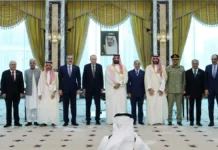
The leaders of eight Muslim-majority states: Qatar, Saudi Arabia, UAE, Türkiye, Indonesia, Egypt, Jordan, and Pakistan, who met Trump on the sidelines of the 80th UN General Assembly in New York, had expressed support for the plan in a joint statement, praising his “sincere efforts to end the war in Gaza” and expressing confidence in his ability to achieve peace. However, the text of the plan released subsequently has raised concerns among Arab countries and drawn significant domestic criticism, as it deviates from the proposals of the foreign ministers of the eight Muslim states. Reports indicate that Israeli Prime Minister Benjamin Netanyahu secured “the last word,” persuading Washington to make additional changes at a stage when it was harder for the Muslim countries to intervene.
How the Gaza question is resolved — whether as a primarily security-led stabilization by disarming, re-building, and technocratic governance or as a political settlement that recognizes Palestinian political rights in a durable way — is yet to be seen. An Israeli-U.S. approach that produces security and normalization without a credible, enforceable pathway to Palestinian political rights and without addressing refugee claims, settlements or permanent borders risks locking in a durable, managed status quo that advantageously cements Israeli gains and rewards Arab normalization while leaving Palestinian grievances unresolved.
For critics and many Palestinians, the plan’s biggest flaw is that it recapitulates the old “deal by omission” problem — postpone the hard political questions and hope that security fixes suffice. Robert Malley’s long reflection on the failure of past peace processes is a timely reminder that postponing core issues almost guarantees revival of conflict rather than durable peace.
Shift in the Middle East Balance of Power
Since Trump’s first term in power led to Abraham Accords in September 2020, the Middle East is undergoing tumultuous shift in the balance of power. This shift is away from Iran’s axis of resistance and towards those that signed the Abraham Accords – and others that were moving towards accepting it. Highlighting plans to expand the signatories to the Abraham Accord and emphasizing the strategic and economic benefits of cooperating with Israel, Trump recently stated:
“History has shown us that those who establish relations with Israel have thrived, while those who devote resources and attention toward the destruction — even the annihilation — of Israel have languished. Israel is not going anywhere. They are going to coexist with other peoples and countries in the region. The Abraham Accords demonstrate that nations are better off when they communicate, work together, and embrace new opportunities.”
The last five years have seen aggressive Israeli campaigns and intelligence operations directed at damaging — sometimes decisively — Iran’s regional network: kinetic blows, targeted assassinations of key operatives in Iraq, Syria, Lebanon and Yemen, and continued pressure on Iran’s enlistment of militias. Another focus has been the degrading of Iran’s nuclear ambitions, whether by eliminating key scientists, or by cyberattacks on its nuclear facility. In June, US also carried out bombing of the Iran’s nuclear facilities in Fordow, Isfahan, and Nanatz sites.
The net effect has been to cripple Iran’s reach: Hezbollah was weakened on the battlefield during the 2023–24 rounds of fighting; Iran’s Quds Force lost its most iconic commander in Qasem Soleimani in January 2020. Recently, Isreal shifted its focus to the political leadership, which lead to the assassination of Ismael Haniyeh on Iranian soil in July 2024, followed by elimination of Hassan Nasrullah in Lebanon in September 2024. However, it was the Israeli attack on Hamas negotiators in Doha last month that many experts believe may have broken the camel’s back. It blurred the line of who is Israel after – and what does it want to achieve with all the mayhem that followed Oct 7, 2023, tragic Hamas attack on Israel. The campaign against Iran has demonstrated that Israel can play with international rules at will and without any consequences. This will have grave long-term consequences for global order.
But degradation does not mean elimination — proxies adapt, civilian costs grow, and local politics evolve in unpredictable ways. Alongside coercion and violence, normalization diplomacy has quietly reshaped the balance. The Abraham Accords proved that several Arab states were prepared to prioritize trade, technology, and counter-Iran cooperation, over the old formula that required Palestinian statehood before normalization. This bargain created an “outside-in” model of Israeli influence — Israel’s security and economic ties extend into the Arab world even as its control over Palestinian territories and the facts on the ground become more entrenched.
That model has a dual consequence: it strengthens Israel’s regional legitimacy and deterred coalitions, but it also delegitimizes the Palestinian cause in some Arab capitals. Unless meaningful political concessions accompany normalization under the current rounds of peace accords – the situation may plan in the hands of hardliners in the longer run.
Reshaping the New Middle East
The 20-point Trump plan thus revolve around two linked wagers.
First: can an externally led, security-first approach end immediate bloodshed and create a stable environment for reconstruction? Second: can that short-term security compact be turned into a politically legitimate, durable settlement that includes Palestinian rights and prevents radicalization? If the answer to the second question is “no,” then any tactical success will be ephemeral — the security gains will ossify into new grievances and a renewed cycle of violence.
If the American-Israeli tack succeeds in producing a stable Gaza that is demilitarized, internationally managed and economically rebuilt — but without a credible pathway to Palestinian statehood, refugee resolution, or substantive political participation — the regional consequence is likely to be twofold:
(a) the anti-Abraham Accord camp will consolidate, and (b) the Palestinian national cause shifts from mainstream diplomacy back to asymmetric forms of resistance and transnational advocacy. That benefits actors that can exploit grievances — whether non-state actors in the region or international rivals that seek influence by presenting themselves as alternatives to the U.S. model.
Middle East and the Global Balance of Power
Potential failure of the U.S.-Israeli approach does not automatically favor China and Russia — but it creates openings. China and Russia are playing a long game: both have expanded political and economic ties in the Middle East, offering infrastructure, arms, and diplomatic cover without the political conditionalities the West often attaches. Beijing’s economic footprint, growing role in regional institutions, including BRICS partners, and willingness to court Gulf states for energy and investment means it can offer attractive alternatives to American dependency.
Moscow, for its part, remains an arms supplier and a diplomatic interlocutor (especially in Syria), and it relishes opportunities to undercut U.S. influence. If Washington’s approach produces stability without justice, public sentiment may turn away from the U.S. narrative and look to non-Western partners who promise investments or political balance-as as has already started to occur. That said, China and Russia do not currently possess the same depth of security integration with Israel or the same network of alliances that would let them ‘replace’ American influence overnight — what they can do is exploit U.S. credibility gaps to gain economic and political footholds.
The Way Forward
Three practical conclusions emerge from a realistic appraisal of Trump’s 20-point plan:
- Security outcomes are necessary but not sufficient. Short-term stabilization that includes hostage releases, ceasefires, and reconstruction, is important and politically urgent — but by itself it will not end the conflict’s structural drivers. The old lesson of Oslo remains: postponing core grievances breeds future crises.
- Normalization without a political track is a strategic accelerant for some actors and a strategic liability for others. States that prioritize economic and security ties with Israel will gain leverage; however, the Arab and Muslim Street will judge outcomes by whether justice is achieved for Palestinians.
- Geopolitically, every gap left by U.S. leadership, or perceived U.S. indifference to justice, creates space for China and Russia to expand influence — primarily through diplomacy and investment, and secondarily through arms and political support. But neither Beijing nor Moscow offers a ready-made substitute for U.S. regional security guarantees; rather, they offer alternative hedges that regional states will use in pursuit of their own short-term interests.
If Cairo deal and the Trump package are to avoid merely delaying the next crisis they must do three things simultaneously:
Secure an immediate end to mass killing and human suffering; create an inclusive, accountable reconstruction process that gives Palestinians meaningful agency; and set out an enforceable, internationally backed political roadmap that addresses, not postpones, refugee claims, borders and sovereignty – as was done in the Oslo Accords. Without that tripod, any “victory” will be tactical, not strategic — and the balance of power will keep shifting unpredictably, with winners among states and non-state actors who are best at exploiting unresolved grievances.
Related Articles:
Israel Airstrike Targets Hamas Negotiators In Doha, Threatening Gaza Ceasefire Talks – Sep 15, 2025
Gaza Ceasefire Plan And US-Iran Tensions – April 26, 2025
Two-State Solution, Future Of Gaza, And Iran – February 25, 2025
Assad’s Demise And The Shifting Balance Of Power In Middle East – Dec 26, 2024
The Escalating Middle East Crisis And President Elect Trump – Dec 5, 2024
Iran’s Potential Retaliation For Haniyeh’s Killing And Wider Consequences – Aug 30, 2024
The Iran-Pakistan Gas Pipeline Project: Economic and Geopolitical Realities – Sep 27, 2024
What Does President Biden’s Visit To Israel And Saudi Arabia Imply? – Aug 4, 2022