By Naade Ali
President Trump and Crown Prince Mohammed bin Salman (MBS) are redefining the U.S.-Saudi alliance to address China’s rising influence and the Gaza crisis, effectively moving the partnership beyond its traditional foundations. Since their inception, the Saudi-US relations have experienced fluctuations but have been sustained by overlapping strategic interests and mutual dependencies. At the center of their crucible of interaction stood a security–petrodollar arrangement. Even when relations hit their lowest point, the core bargain held: Saudi Arabia continued selling oil in dollars and remained a key supplier to the United States, while Washington preserved its role as the Kingdom’s primary security guarantor and leading defense provider.
However, shifting global dynamics, fueled in part by intensifying great power competition between China and the United States, have pushed middle powers like Saudi Arabia to reduce their dependence on any single major actor and seek greater strategic autonomy. While this shift has broadened their ambitions, it has also uncovered greater opportunities and challenges. The Saudi-US relations are not indifferent to these evolving dynamics, with both countries recalibrating their bilateral ties along new strategic dimensions.
Saudi Arabia as a Swing State in the U.S.–China Rivalry
Today’s Saudi Arabia appears to be hedging away from over reliance on the United States, building a strategy centered on its pragmatic interests and exercising sovereign leverage. This helps in deal-making and to secure the space needed to navigate the great power rivalry. Saudi Arabia’s move to reduce its dependence on the United States gained momentum exactly when ties with Washington soured under the Biden administration. Confronted with the unpredictability of American policy, Crown Prince Mohammed bin Salman (MBS) found an attractive alternative in Beijing, which offered strategic engagement without preconditions. Closer ties with China enabled Saudi Arabia to pursue a multidimensional strategy, diversify its partnerships, and maintain the flexibility necessary to manage uncertainties in its relationship with Washington.
For China, Saudi Arabia became a central pillar for expanding regional influence in the Middle East. Riyadh hosted the first-ever China-Arab States Summit and, through Beijing’s mediation, reconciled diplomatic ties with Tehran. Further consolidating their ties with Beijing, both Tehran and Riyadh also integrated into multilateral blocs where China and Russia hold considerable sway, including the Shanghai Cooperation Organization and BRICS. Additionally, China strengthened economic relations with the Kingdom, becoming its largest trading partner and providing robust support for Vision 2030. A major payoff of Saudi Arabia’s strategic pivot toward China was that it transformed Saudi Arabia into a geopolitical swing state. This effectively signaled to Washington it is fully prepared to deepen ties with Beijing unless the U.S. proactively restores its coveted central role.
The Trump–MBS Summit: A Strategic Inflection Point
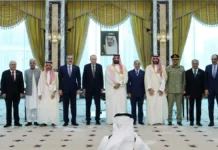
President Trump’s extraordinary embrace of Mohammed bin Salman during his visit to Washington in November suggests that Riyadh’s calibrated swing-state posture is working. Riyadh now carries significant geostrategic weight and has taken center stage in the U.S.–China competition for influence in the Middle East.
Trump’s approach to strategic competition with China rests on two pillars: credible deterrence and tightening of alignment with key U.S. middle power partners. Within this framework, any complete Saudi drift into Beijing’s orbit is viewed as strategically unacceptable. At the same time, he is acutely aware of the practical limits of attempting to sever Riyadh’s growing relationship with Beijing, recognizing that containment of China cannot succeed solely through coercive pressure on allies to reverse course.
As evidenced by President Trump’s foreign policy conduct, he employs a distinctive blend of generous incentives and far-reaching, exclusive agreements in energy, critical minerals, technology, and defense. These arrangements simultaneously fortify bilateral partnerships and allow middle powers, such as Kingdom of Saudi Arabia, to maintain a semblance of strategic autonomy in their relations with China. Beneath this veneer, however, the United States methodically secures alignment on matters of vital national interest, while deliberately imposing significant strategic costs on any partner that leans excessively toward Beijing.
Nevertheless, Trump’s transactional foreign policy has provided Saudi Arabia with an opportunity for adjusting its own strategy, allowing the Kingdom to pursue a more robust, interest-driven relationship with Washington. Riyadh recognizes that being a center of the Islamic holy places provides it immense influence in the Muslim world. United States relies on it not only to balance China in the Middle East but also to help secure a stable regional environment for Israel. This is a goal that, in Trump’s view, could be advanced if Saudi Arabia joins the Abraham Accords, potentially encouraging other Arab and Muslim countries to follow suit.
The Summit Outcome
Through Vision 2030 reforms and skillful diplomatic maneuvering, the Kingdom has transcended its traditional role. This transformation not only redirects the calculus of their bilateral partnership but also carries profound implications for the Middle East’s balance of power and the broader dynamics of great power competition. It has emerged as a pivotal regional powerhouse whose energy resources, vast investment capital, and geopolitical influence make it indispensable to both Washington and Beijing.
During their meeting, President Trump stated he was “the best friend Saudi Arabia has ever had in Washington,” a statement that highlighted his administration’s desire to deepen ties through personal rapport. Nevertheless, the agreements concluded between the two leaders demonstrate that the U.S.-Saudi relationship remains firmly grounded in their respective national interests and strategic imperatives, with both seeking to extract maximum advantage.
President Trump secured a $1 trillion investment pledge from the Crown Prince, alongside the signing of a Strategic Framework for Cooperation. This framework includes Saudi commitments to supply uranium, metals, permanent magnets, and critical minerals essential for U.S. defense and energy sectors. Leveraging Saudi Arabia’s vast deposits of rare earth elements (REEs), Trump advanced his goal of countering China’s dominance in critical minerals.
For his part, Crown Prince achieved major strategic gains: the Kingdom was granted major non-NATO ally status, a defense agreement was finalized, and approval was secured for the purchase of American F-35 fighter jets and other advanced weapons. These acquisitions will strengthen Saudi defense architecture. Additionally, in line with its ambition to become a global hub for artificial intelligence, Saudi Arabia also gained access to advanced AI chips and U.S. technology firms to support the development of its domestic AI infrastructure.
US-Saudi Ties and Gaza Peace Plan
The Washington meeting between President Trump and the Crown Prince highlighted both progress and persistent challenges in U.S.–Saudi relations, with Saudi-Israel normalization remaining a key point of divergence. While Trump pressed Saudi Arabia to join the Abraham Accords, Mohammed bin Salman insisted that any normalization depend on Israel committing to “an irreversible, credible, and time-bound path toward Palestinian statehood.” Following the Israel–Gaza conflict, Riyadh has emerges as a leading advocate for international recognition of Palestine, a position consistently opposed by the U.S. and Israel. Its refusal to yield to Trump’s push for normalization reflects the broader post-war realities in Gaza.
By taking this stance, Crown Prince delivered a twofold message: First, the strengthening of U.S.–Saudi ties must remain entirely independent of any precondition for Saudi–Israeli normalization. Second, while Riyadh is open in principle to normalization, Israel’s refusal to recognize Palestinian statehood remains a major impediment. While Riyadh supports the Trump Gaza peace plan in principle, it rejects full Israeli control over the Gaza territory and insists on concrete conditions: a time-bound Israeli withdrawal, the deployment of an international protection force, and the reinstatement of authority to the Palestinian Authority.
Saudi Arabia’s demands on the Palestinian issue clash directly with Israel’s red lines, leaving Washington struggling to balance relations with both capitals. From Israel’s viewpoint, the rapidly deepening U.S.–Saudi partnership, explicitly decoupled from any obligation of Saudi–Israeli normalization, raises two profound concerns. First, it risks elevating Riyadh’s regional influence while undermining Israel’s primary strategic objective: the expansion of the Abraham Accords. Second, as long as Riyadh continues to regard Israel as a principal source of regional instability, not Iran, the possibility persists that Saudi Arabia could further deepen its relations with Iran.
Historically, the shared enmity toward Iran has been the bedrock of both the U.S.–Israel alliance and U.S.–Saudi security relations. Following their China-brokered détente, Riyadh and Tehran no longer see each other as existential threats. To prevent Washington from viewing improved Saudi–Iranian ties with alarm, Mohammed bin Salman has carefully framed them as potentially beneficial to the United States, offering to help the U.S and Iran reach a deal that could be vital to regional stability. Riyadh can indeed encourage Iran to talk, but persuading Tehran to accept U.S. terms is no less daunting than U.S. convincing Israel to meet Saudi demands on Palestine. The scenario thus exposes the limits of influence on both sides: neither Washington nor Riyadh can fully impose their will on Israel and Iran.
The Washington summit also revealed a deeper convergence: the United States and Saudi Arabia need each other to achieve their core objectives in the Middle East. Under the Trump approach, US appears willing to delegate primary responsibility for preserving and enforcing the U.S.-led order in the Middle East to Saudi Arabia. However, for Riyadh to fully assume the role of America’s pre-eminent regional partner, it will also have to bear the main burden of protecting U.S. interests, containing rivals, and upholding the existing regional architecture.
Such an alignment would signal to Iran that Saudi Arabia had become the de facto guarantor and enforcer of core American interests. A U.S.–Saudi power-sharing arrangement would also carry significant implications for Israel. Confronted with a region increasingly shaped around Saudi primacy, Israel would face a stark choice: either challenge Riyadh and risk damaging its own relationship with Washington, or accommodate Saudi terms and move toward normalization on conditions set by the Kingdom. Under this approach, in which Saudi Arabia and the United States emerge as mutually reinforcing strategic partners, both are able to secure the outcomes they seek from Iran and Israel.
The Saudi-UAE Rivalry and Yemen Conflict
As the new year begins, the region is no longer defined by “Arabs vs. Iran” or “Islamists vs. Monarchies,” but by the fallout of weakening Iran that is creating a power vacuum. Muslim Middle Powers are competing to to fill the space, illustrated by the Saudi-UAE split. In places of old alliances, new ones are taking shape premised on cold, transactional game of national interest. And these tensions are playing out from Yemen to Syria, Sudan, Libya, and Somalia.
While the Trump-MBS summit secured vital U.S. interests in energy and defense, it exposed the fragility of the broader regional architecture. Saudi Arabia is acting like a state, prioritizing borders, stability, and institutions to protect Vision 2030. The UAE resembles a corporation, prioritizing ports, trade routes, and resource extraction. Turkey and Qatar are navigating the space between them, leveraging their military and ideological assets to carve out their own spheres of influence.
Similarly, President Trump’s “20-Point Peace Plan,” unveiled in September 2025, was predicated on a unified regional architecture: Gulf capital would fund reconstruction, Egyptian-Turkish logistics would secure the ground, Pakistan-Indonesia-Turkey may be part of the International Stabilization Force (ISF), and Israeli-Saudi normalization would provide the political horizon.
As of late December 2025, the dramatic rupture between Saudi Arabia and the UAE—culminating in the Saudi airstrike on UAE-backed assets in Mukalla, Yemen—has shattered the “Sunni Coalition” prerequisite for the plan’s success. The 20-point framework is now being pulled apart by the competing power centers and Israel may find itself the short-term beneficiary of Arab fragmentation. Unless Washington can repair the rupture within the Gulf Cooperation Council, its grand strategy for the Middle East risks becoming a two-legged stool: supported by a strong U.S.-Saudi bilateral deal, but lacking the regional stability required to stand.
Related Articles:
Israel Airstrike Targets Hamas Negotiators In Doha, Threatening Gaza Ceasefire Talks – Sep 15, 2025
Gaza Ceasefire Plan And US-Iran Tensions – April 26, 2025
Two-State Solution, Future Of Gaza, And Iran – February 25, 2025
Assad’s Demise And The Shifting Balance Of Power In Middle East – Dec 26, 2024
The Escalating Middle East Crisis And President Elect Trump – Dec 5, 2024
Iran’s Potential Retaliation For Haniyeh’s Killing And Wider Consequences – Aug 30, 2024
The Iran-Pakistan Gas Pipeline Project: Economic and Geopolitical Realities – Sep 27, 2024
Great Power Rivalry And China’s Deepening involvement In South Asia, Gulf States – Aug 4, 2023
What Does President Biden’s Visit To Israel And Saudi Arabia Imply? – Aug 4, 2022