By Arif Ansar
Context
The November 2026 United States midterm elections delivered a decisive political rebuke to the White House, handing control of both the House of Representatives and the Senate to the Democratic Party. While President Donald Trump retains executive authority for the remaining two years of his term, the end of unified Republican governance fundamentally alters the trajectory of American domestic politics and global statecraft. Driven largely by voter anger over inflation, fuel prices, and an unpopular military conflict with Iran—a reality acknowledged publicly by both President Trump and Vice President JD Vance—the electoral outcome ushers in an era of divided government in Washington. For international allies, adversaries, and middle powers alike, the central challenge over the next twenty-four months is navigating an increasingly unpredictable U.S. executive constrained by an assertive opposition Congress, even as the global order fractures.
Domestic Paralysis, Fiscal Brinkmanship, and the 2028 Horizon
The immediate consequence of the Democratic sweep is the transition from unilateral executive dominance to institutional gridlock and intense congressional oversight. Over the past two years, the Trump administration executed major domestic and foreign policy shifts—from sweeping tariff regimes to military interventions—with minimal legislative friction. Beginning in January 2027, incoming Democratic committee chairs in both chambers will possess subpoena power, appropriations leverage, and the ability to block executive nominations.
In the immediate term, Washington faces acute fiscal brinkmanship during the post-election lame-duck session. With federal funding deadlines approaching in December, lawmakers must decide whether to finalize full-year spending bills or pass stopgap measures under the shadow of a potential government shutdown. While Democratic appropriators have signaled a desire to avoid a shutdown so they can focus on cost-of-living legislation in the new year, ideological clashes over defense spending, Pentagon leadership, and war funding threaten to paralyze budget negotiations well into early 2027.
Internationally, foreign capitals are already looking past 2028 to determine whether the post-World War II liberal international order can ever be restored. Even if a Democratic president wins the White House in 2028, a clean reversion to pre-Trump orthodoxy is highly unlikely. The economic grievances that fueled the “America First” movement—deindustrialization, supply-chain vulnerabilities, and middle-class wage stagnation—have reshaped both American political parties. While a future Democratic administration would likely temper unilateral tariff wars with traditional allies and recommit to multilateral institutions, targeted industrial protectionism, skepticism of open-ended overseas troop deployments, and rigorous burden-sharing demands on allies have become bipartisan fixtures of American international relations. Furthermore, the midterm backlash has fractured the Republican coalition itself, sparking internal debates between traditional hawks and populist isolationists over the political cost of foreign entanglements.
The Middle East: The Iran War, GCC Hedging, and the Palestinian Question
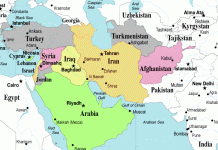
Nowhere are the contradictions of current U.S. foreign policy more acute than in the Middle East. Having campaigned on ending “forever wars,” the administration’s decision to launch military operations against Iran alongside Israel in February 2026 upended its domestic political coalition and sent shockwaves through global energy markets. Following the midterm losses, Vice President Vance explicitly attributed the Republican defeat to the conflict with Iran and the resulting cost-of-living pressures, signaling an effort to distance his own political future from the war. President Trump now faces a stark strategic dilemma: escalating the conflict risks further spikes in global oil prices and deeper domestic unpopularity, while pursuing a diplomatic exit without clear strategic gains invites accusations of retreat.
The incoming Democratic Congress will immediately target the administration’s war-making authority. Having already mounted bipartisan war powers challenges in the House prior to the election, Democrats are positioned to use the power of the purse and War Powers Resolution votes to restrict funding for offensive operations against Tehran. While the president retains broad constitutional authority as Commander-in-Chief and can veto restrictive legislation, congressional pushback weakens Washington’s coercive leverage in ongoing diplomatic mediation.
For the Gulf Cooperation Council (GCC) states, the war has fundamentally altered the regional balance of power. Attacks on regional shipping, energy infrastructure, and Gulf airspace have exposed the limits of the American security umbrella. Realizing that Washington is neither willing nor politically able to guarantee absolute security against regional escalation, GCC capitals have accelerated their strategic hedging—deepening economic and diplomatic ties with China, maintaining working channels with Russia, and pursuing direct de-escalation with Tehran.
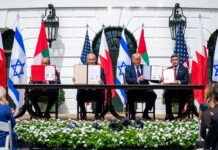
Simultaneously, the unresolved Israeli-Palestinian conflict and ongoing hostilities in Gaza, the West Bank, and southern Lebanon continue to polarize both American domestic politics and regional diplomacy. Progressive and mainstream Democrats elected in 2026 campaigned heavily on conditioning military aid to Israel and addressing the humanitarian crisis in Palestinian territories. Consequently, as regional analysts note regarding the Democratic sweep’s impact on the Middle East, the U.S.-Israeli relationship faces heightened friction over the next two years, while Saudi-Israeli normalization remains stalled due to Riyadh’s insistence on credible pathways toward Palestinian statehood.
Europe, NATO, and Great-Power Spheres of Influence
In Europe, the midterm results were greeted with a mixture of cautious relief and strategic realism. Over the past two years, the administration’s transactional approach to the Russia-Ukraine war, skepticism toward Article 5 collective defense commitments, and gradual drawdown of U.S. force posture in Europe have severely strained transatlantic cohesion. Coupled with Washington’s broader preference for managing great-power rivalry through tacit “spheres of influence” among the United States, Russia, and China, European leaders have been forced to confront the prospect of a post-American security architecture.
A Democratic-controlled Congress provides European allies with a vital institutional counterweight in Washington. Congressional majorities can pass legislation prohibiting unilateral troop reductions in Europe below statutory thresholds, reinforce NATO funding, and authorize new military assistance packages for Kyiv. However, as European policy experts observe in assessing transatlantic security after the 2026 midterms, European policymakers recognize the constitutional limits of Congress: legislators cannot force the executive branch to disburse appropriated aid rapidly, nor can they prevent the White House from pursuing bilateral negotiations with Moscow over Kyiv’s head. As a result, the midterms will likely slow down—rather than reverse—American military retrenchment from the continent. European powers must continue accelerating their own defense industrial integration and strategic autonomy, recognizing that middle powers across Eurasia can no longer outsource their security to Washington.
Implications for Pakistan and India-Pakistan Dynamics
This turbulent realignment in Washington carries profound consequences for Pakistan, which has spent the past two years cultivating personal, leader-to-leader ties with the Trump administration. Islamabad’s renewed diplomatic visibility—anchored by counterterrorism cooperation, critical mineral discussions, and high-level military-to-military engagement—relied heavily on personal rapport with the White House. With Democrats now controlling the House Foreign Affairs and Senate Foreign Relations committees, that narrow executive-centric strategy is no longer sufficient.
As regional observers have noted regarding how the midterms could reshape U.S.-Pakistan relations, Pakistan may urgently need to build institutional bridges with Democratic lawmakers, who traditionally place greater emphasis on democratic governance, human rights, and civil-military balance than the Trump White House. Historically, Pakistani governments have relied on the Pakistani-American diaspora to lobby Capitol Hill. Thus, a campaign to favorably tilt the perception of US-Pakistan diaspora is already underway – especially geared towards the younger generation and harnessing the Pakistan origin businessmen. Their perceptions will be critical on how the Congress, and the potentially the new president in two years, will position the US policy.
These parallel shifts in Washington’s relations with New Delhi and Islamabad directly alter the dynamics of India-Pakistan ties. Over the past two years, President Trump’s personalized outreach to Islamabad—had irritated New Delhi and complicated India’s long-standing insistence on strictly bilateral dispute resolution. A Democratic-controlled Congress may act as a structural stabilizer in South Asia by reaffirming Washington’s institutional preference for strategic partnership with India while discouraging erratic White House diplomatic overtures toward Islamabad.
However, the broader geopolitical fallout of the midterms constrains both South Asian rivals in different ways. On its western border, Pakistan remains locked in a sustained, deadly conflict with the Afghan Taliban since cross-border hostilities escalated into open clashes over Tehreek-e-Taliban Pakistan (TTP) sanctuaries, alongside a surge in militant attacks along the border. Simultaneously, the U.S.-Iran war threatens Pakistan’s fragile economy through elevated energy prices and heightened instability along its southwestern border in Balochistan. While Pakistan’s acute economic distress and two-front border instability limit its capacity for conventional escalation against India, a distracted United States—consumed by domestic gridlock, the Gulf war, and European security—also lacks the diplomatic bandwidth to serve as an effective crisis manager if a major terrorist attack or border incident triggers a sudden India-Pakistan military standoff. Left without an active Washington safety net, New Delhi and Islamabad must manage their fraught deterrence relationship directly in an increasingly volatile multipolar neighborhood.